
Gamdom mobile browsing, app claims and phone security
 Available in AU
Table of Contents
- A small screen makes deceptive links easier to miss
- An unofficial app can imitate a legitimate mobile product
- Support contact is a separate trust boundary
- The browser keeps the same financial rules on a smaller display
- Questions about Gamdom mobile features
- A browser-first product with distinct impersonation risks
Section element
Gamdom presents its casino through a mobile web experience rather than through a native app supplied by the operator. That distinction affects how a phone reaches the service, how an apparent download should be judged and how account details can be exposed to impersonators. A phone screen makes games, chat and account information compact, but it does not make the underlying transactions or account rules lighter. The most consequential mobile question concerns whether the browser is communicating with the intended service or with a convincing imitation.
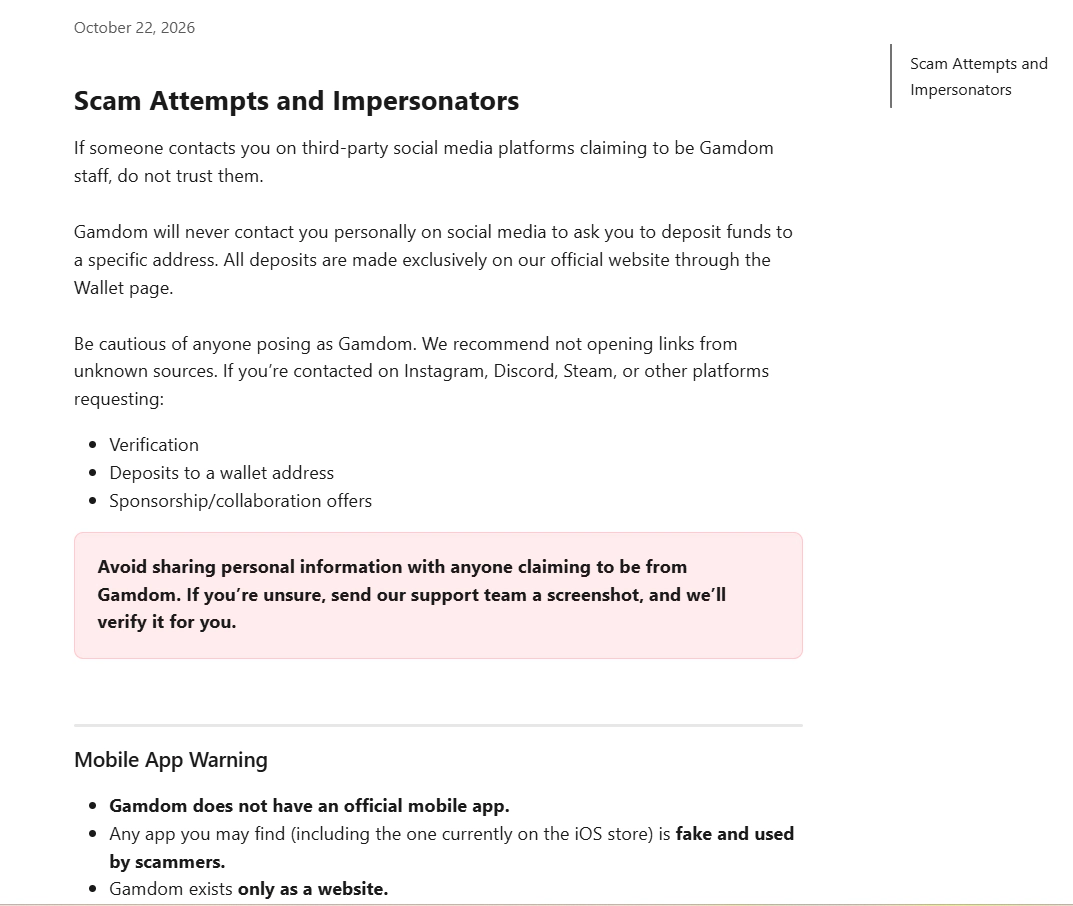
Gamdom explicitly warns that it has no official native mobile application and that impostors may represent themselves as its staff or distribute misleading app links. The web browser is therefore the relevant product format. A store listing or installation package that uses the Gamdom name should not be equated with a publisher-approved app. Downloading an unknown installer can expose both device permissions and any credentials entered later.
Mobile risk also reaches beyond downloads. Small screens can obscure a complete address, make permission requests easy to skim and compress a long game history into a few short views. These conditions matter when a message claims to be support, when a site requests identity documents or when a cryptocurrency address is being copied. The account and identity-check guide covers the policy behind verification; the focus here is the device and communication channel through which that information is handled.
A small screen makes deceptive links easier to miss
Mobile devices display a shortened version of many addresses and browser controls. A fraudulent site can use a similar name, matching colours or a familiar-looking icon while sending information to an unrelated domain. The visible title of a page is therefore a weak sign of who operates it. A malicious page can copy public artwork without gaining any legitimate connection to the original operator. A genuine-looking layout is especially easy to mistake for authority when most of it fills a narrow screen.
Gamdom has publicly warned about people posing as staff on third-party social-media channels. That warning is relevant to phones because chat invitations, shortened links and notifications can move a reader rapidly from a familiar platform into a different website. A support message and an authenticated account-support channel are distinct things. The conversation’s sender name does not establish that the person controls an official support account.
Four mobile signals deserve separate attention
- Destination address: the real domain matters more than the link caption or profile picture. Lookalike spellings can be difficult to notice when the address bar is collapsed.
- Requested permissions: a request for contacts, message access or broad device privileges should be evaluated on its own merits, especially when it arrives with a supposed installer.
- Identity requests: a photo of an identity document or selfie carries lasting privacy consequences; a casual direct message is different from a controlled account process.
- Transaction details: copying a wallet address and choosing a network demand independent attention, because blockchain settlement often cannot be cancelled.
These signals serve different purposes. A browser certificate helps protect a connection to a particular domain, but it does not prove that the domain is the intended business. Likewise, a download from a familiar app marketplace is not a substitute for the operator’s own statement about whether a native app exists. Device hygiene reduces common exposure without guaranteeing protection from sophisticated social engineering.
Physical access to a phone also affects account security. Notifications may reveal one-time codes on a lock screen, password managers may autofill fields into a plausible imitation, and shared devices may preserve authentication state after the user has finished. These are ordinary mobile-account hazards rather than features unique to Gamdom. Distinguishing the account owner from the device holder is essential when a phone is borrowed or resold.
There is a further difference between looking at a game and making a financial decision on a phone. Tight spacing, rapid animations and repeated rounds can conceal the cumulative sum committed over time. The casino game formats guide explains how live tables, slots and Originals create different pacing and outcome patterns. Mobile presentation changes the interface, while those mathematical risks stay with the underlying game.
An unofficial app can imitate a legitimate mobile product
Gamdom says it does not provide an official native mobile app. Its mobile presence is the website accessed through a browser. This is a positive identification of the product channel and a practical warning about downloads bearing the brand name. A file labelled as a Gamdom installer, or a marketplace entry showing a Gamdom-style icon, does not acquire authenticity merely from its branding.
Impersonation can take several forms. A downloadable package might display a convincing home screen before requesting credentials; a webpage may encourage a shortcut that looks like a stand-alone application; or a social account may claim to offer special assistance with a supposed mobile version. These are general attack patterns, not allegations that any named app-store listing is malicious. The central risk is that the user may submit a password or identity material to a party unrelated to Gamdom.
Browser pages, shortcuts and installed apps are different
| Mobile format | Where the experience runs | What a reader should understand |
|---|---|---|
| Mobile website | In a web browser | The destination domain identifies the site being reached |
| Home-screen shortcut | Browser-based page launched from an icon | An icon can resemble an app without proving a native app exists |
| Native installation | Package installed on the device | Permissions and software publisher require separate trust decisions |
The distinction is useful because a home-screen icon by itself is not a technical guarantee. Some browsers can save a shortcut that resembles an app tile. That shortcut can still open a normal webpage, and its presence does not establish the existence of a native Gamdom application. Conversely, a third-party package might function as an app even when it has no connection to the business whose name it uses.
Malicious downloads can create risks beyond a single password. Excessive permissions might expose stored photographs, notification content or information copied to the clipboard. Overlay techniques can put fake fields in front of genuine pages. A person who receives a link from an alleged support representative has to consider the destination and the requested actions separately from the representative’s explanation.
A useful distinction in fraud analysis is between account identity and device identity. An attacker who controls a counterfeit page may learn credentials; an attacker who obtains high device permissions may see information outside that page. Those are different threats and require different containment measures. The absence of an official native app removes any basis for treating a downloaded Gamdom-branded package as a normal installation path.
Support contact is a separate trust boundary
Gamdom provides live chat, which it advertises as available 24/7, and an official support email address: [email protected]. These channels are important because account questions often involve personal information or payment evidence. Their stated existence does not make an unsolicited outreach message authoritative. Someone who appears in a social inbox claiming to represent support may be an impersonator even if the message includes accurate public details about the brand.
Mobile messaging makes this boundary easy to cross. One tap can take a user from a notification into a chat thread, then to a form requesting login details or identity documents. The thread may look conversational, while the destination page handles sensitive data. An authentic support address and a profile name containing the word Gamdom are not equivalent signals. When interpreting a request, the message’s provenance and its content both matter.
A support record should be specific and restrained
- Define the issue: note whether it concerns account access, a suspected impersonation attempt, an identity request or a payment record.
- Retain relevant evidence: preserve message text, approximate sequence and transaction references where appropriate rather than repeatedly forwarding complete documents.
- Separate public from sensitive details: an account identifier and a problem description are different from credentials, recovery codes and full personal records.
- Identify the channel: keep clear which message came from the operator’s described support service and which arrived through a third-party platform.
Gamdom’s identity policy is conditional, meaning an account may be asked for further evidence during a review. That policy makes the channel question more significant, because an identity request can sound plausible even when it comes from an impostor. The Gamdom KYC and account rules explain the operator’s described levels of personal information and the relationship between verification and withdrawal reviews.
Account-recovery conversations also have a timing dimension. A person who loses access to a handset may simultaneously lose email notifications or a second authentication factor. That is a general security dependency: a recovery route should not rest entirely on the device whose loss created the problem. Protecting a recovery mailbox and reviewing device access are separate from confirming a particular casino transaction.
Live chat availability is a service characteristic, not a guarantee that a complex complaint will receive an immediate remedy. A mobile conversation can be brief while the underlying verification, payment or account investigation takes longer. For evidence-heavy issues, the content and continuity of the record matter more than the apparent speed of a first chat response.
The browser keeps the same financial rules on a smaller display
A mobile browser can present game menus, account sections and support features without installing a dedicated native application. That portability is an interface characteristic: it changes the device used to view the product, not the mathematical model of its games or the conditions attached to payments. Gamdom’s catalogue includes slots, live tables and in-house Originals, which can occupy different amounts of screen space and operate at different round speeds.
Small displays alter how much context remains visible at once. A game may keep its main controls in view while putting paytables or supporting explanations behind another panel. A payment screen can show an asset symbol while requiring separate attention to a blockchain network or destination tag. These are examples of why a compact presentation deserves careful interpretation, not descriptions of a particular hidden interface function.
Mobile convenience does not reduce repeated-stake exposure
For games, rapid access can mean that a large number of rounds fits into short intervals of attention. Each new wager still puts funds at risk. A game’s published RTP is a long-run mathematical, whereas an individual session can finish with a very different outcome. An interface that responds quickly may make repetition feel effortless, but speed cannot reduce the expected cost inherent in the game’s rules.
For crypto transfers, a phone can make a mistaken address or network choice difficult to catch. Network charges, conversion effects and irreversible settlement remain relevant whether a transaction begins on a desktop or mobile screen. Gamdom describes several cryptocurrency methods, and different assets may use different chains. The crypto payment and network overview separates those transfer properties from the game experience itself.
Browser-based access also changes how app-like shortcuts should be understood. A saved icon may return to a page through the browser, while a purported installer asks the device to run new software. The reader should not equate those formats based on the look of the icon alone. Gamdom’s own absence-of-native-app statement supplies a clear basis for treating native-download claims with caution.
Finally, mobile usability is not the same as safety. Readable text, correctly rendered controls and a clear payment summary can help a person interpret what is happening, but none can make losses impossible. A user-facing interface is only one layer among gameplay mathematics, identity policy, platform security and payment settlement. Understanding which layer a feature belongs to prevents an attractive small-screen presentation from being mistaken for stronger financial protection.
Questions about Gamdom mobile features
Does Gamdom have an official mobile app?
No. Gamdom says it does not provide an official native mobile app. Its mobile experience runs through the website in a browser.
Why should Gamdom-branded app downloads be treated cautiously?
A name or icon does not establish that a package comes from Gamdom. The operator warns about impersonators and says it has no official native app.
How can an account-support impersonation affect mobile users?
A fake message may direct someone to a lookalike login page or request sensitive documents. A social profile name is not proof of a genuine support channel.
Can mobile play change the odds of a Gamdom game?
No. Screen size and interface layout do not change a game’s underlying rules, expected return or uncertainty of individual outcomes.
A browser-first product with distinct impersonation risks
Gamdom’s mobile format is a browser-based service, with no official native app. That makes suspicious downloads and support impersonation the clearest device-specific hazards, alongside the everyday risks of handling credentials and transfer details on a small screen. Mobile convenience changes access and presentation, while account checks, irreversible crypto transactions and the risk of gambling losses remain separate realities. A familiar-looking icon is therefore a weaker signal than knowing which technology and communication channel is actually involved.